
Why Trenchless Sewer Cleaning Is Becoming Essential for Smart Water Management in Growing Cities
Cities across India and the world are growing at an unprecedented pace. Rapid urbanisation, population density, climate variability, and aging underground infrastructure are putting enormous pressure on water and wastewater systems.
Cities across India and the world are growing at an unprecedented pace. Rapid urbanisation, population density, climate variability, and aging underground infrastructure are putting enormous pressure on water and wastewater systems. While much attention is given to drinking water supply and surface-level infrastructure, the real challenges often lie underground inside sewer lines and drainage networks that are decades old and increasingly overstressed.
Traditional sewer maintenance methods, which rely heavily on excavation and manual intervention, are no longer viable for modern cities. They are disruptive, slow, costly, and unsafe. In this context, trenchless sewer cleaning is emerging as a critical solution one that aligns seamlessly with the principles of smart water management.
By enabling non-invasive cleaning, inspection, and maintenance of sewer systems, trenchless technologies are helping cities protect water resources, prevent flooding, and maintain public health without tearing up roads or risking worker safety. This shift is particularly important in dense urban environments, where disruption and downtime carry high social and economic costs.
This article explores why trenchless sewer cleaning is becoming essential for smart water management in growing cities, how robotic technologies are enabling this transformation, and why approaches like smart sewer cleaning and robotic drain cleaning in India are gaining rapid adoption.
The Growing Challenge of Urban Sewer Infrastructure
Urban sewer networks were often designed decades ago, for populations and waste volumes far smaller than what cities handle today. As cities expand, these systems face several compounding challenges:
- Increased wastewater generation
- Higher solid waste load entering drains
- Irregular rainfall and intense monsoon events
- Aging pipes prone to cracks, corrosion, and blockages
- Limited access for maintenance in congested areas
When sewer systems fail, the consequences extend beyond sanitation. Blocked or damaged sewers contribute to waterlogging, groundwater contamination, overflow into streets and homes, and loss of treated water resources. These failures directly undermine smart water management goals.
To manage water efficiently, cities must ensure that wastewater flows reliably, predictably, and safely without leaks, overflows, or contamination. This is where trenchless approaches become indispensable.
What Is Trenchless Sewer Cleaning?
Trenchless sewer cleaning refers to methods that allow cleaning, inspection, and maintenance of sewer lines without digging up roads or excavating large sections of land. Instead of open-cut operations, these methods use access points like manholes combined with advanced equipment and robotics.
Key characteristics of trenchless sewer cleaning include:
- No road cutting or surface excavation
- Minimal disruption to traffic and daily life
- Faster deployment and completion
- Reduced environmental impact
- Safer working conditions
Trenchless methods often work hand-in-hand with robotic systems, cameras, and sensors, making them a foundational element of modern smart sewer cleaning strategies.
Why Traditional Sewer Maintenance No Longer Works
To understand the value of trenchless methods, it’s important to examine the limitations of traditional approaches.
Surface Disruption and Urban Chaos
Open-cut sewer cleaning requires digging roads, footpaths, and sometimes even private property. In busy cities, this leads to traffic congestion, noise, dust, and extended repair timelines.
High Cost and Time Overruns
Excavation-based methods involve civil work, restoration, and long shutdown periods. The total cost often far exceeds initial estimates.
Limited Frequency of Maintenance
Because traditional methods are disruptive and expensive, maintenance is done infrequently often only after a failure occurs.
Safety Risks
Manual cleaning and confined-space entry expose workers to toxic gases, pathogens, and physical hazards.
These drawbacks make traditional methods incompatible with the continuous, data-driven approach required for smart water management.
Trenchless Sewer Cleaning and Smart Water Management: The Connection
Smart water management focuses on optimising the entire water cycle supply, usage, treatment, and disposal using technology, data, and automation. Sewer systems play a crucial role in this cycle, as they directly affect water quality, reuse potential, and environmental outcomes.
Trenchless sewer cleaning supports smart water management in several key ways:
1. Preventing Water Loss and Contamination
Blocked or damaged sewers can lead to leakage and contamination of groundwater and surface water bodies. Regular trenchless cleaning keeps wastewater flowing correctly, protecting valuable water resources.
2. Enabling Preventive Maintenance
Because trenchless methods are less disruptive, cities can clean and inspect sewers more frequently. This shifts maintenance from a reactive model to a preventive one.
3. Supporting Data-Driven Decisions
When trenchless cleaning is combined with robotic inspection, cities gain real-time data on pipe conditions, sediment buildup, and structural integrity essential inputs for smart water planning.
4. Improving System Resilience
Clean, well-maintained sewers are better equipped to handle peak loads during heavy rainfall, reducing flood risk and system failure.
The Role of Robotics in Trenchless Sewer Cleaning
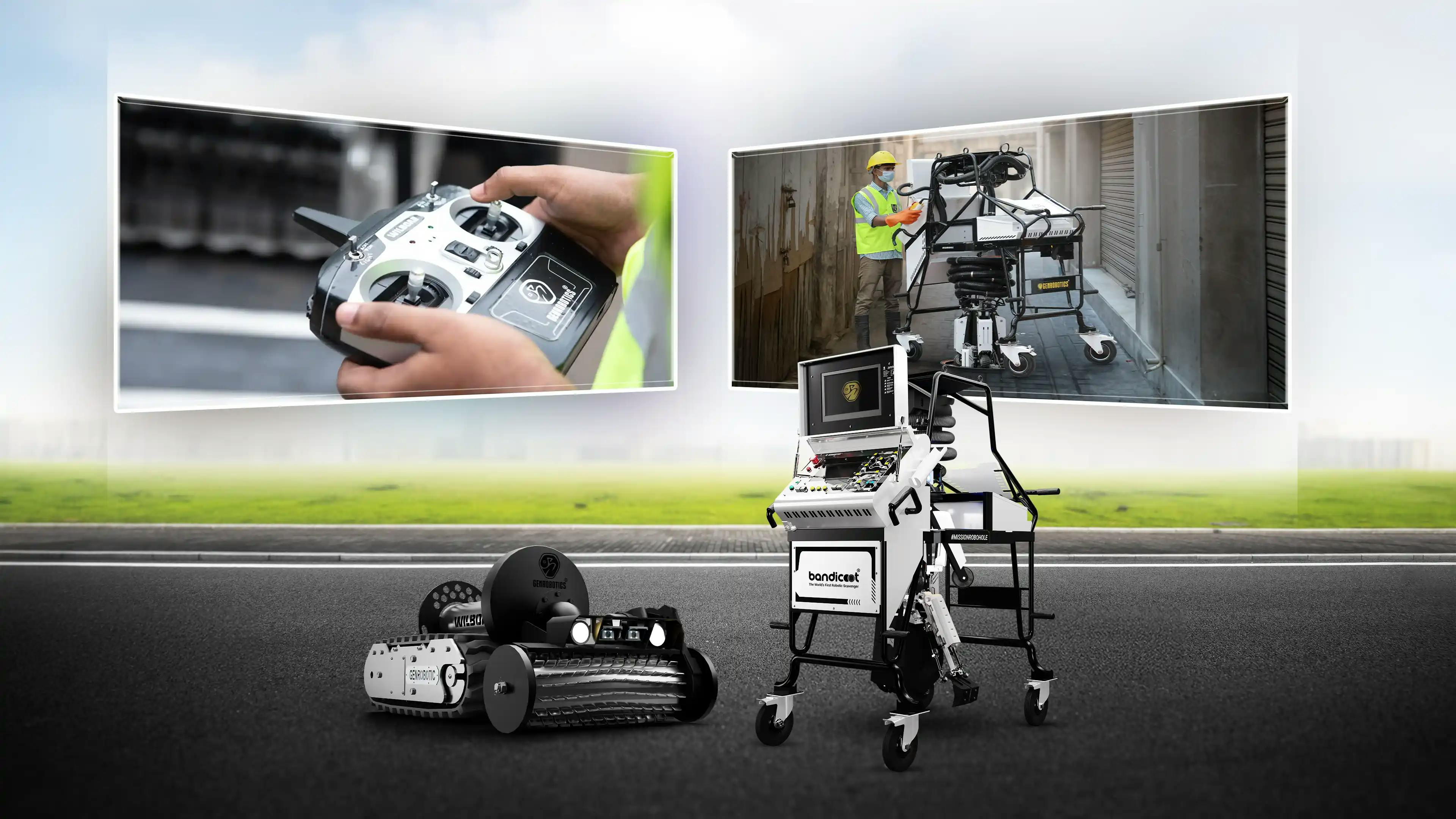
Robotics has become the backbone of modern trenchless sewer cleaning. Instead of relying on water pressure alone or human entry, cities are deploying robotic systems that can clean, inspect, and assess sewers from within.
Smart sewer cleaning systems typically use robots equipped with:
- High-resolution cameras
- Robotic arms for cutting, scooping, and lifting debris
- Sensors for gas detection and environmental monitoring
- Remote-control or semi-autonomous operation
These robots are lowered into manholes and operate entirely underground, eliminating the need for excavation or human entry.
In India, robotic drain cleaning is gaining momentum as cities seek safer, more efficient alternatives to manual sewer work. Companies like Genrobotics have been at the forefront of this shift, developing robotic systems designed specifically for complex urban drainage conditions.
Why Trenchless and Robotic Methods Matter in Indian Cities
Urban environments in India present unique challenges:
- Narrow roads and dense construction
- Mixed sewer and stormwater systems
- Deep and irregular manholes
- High solid waste ingress into drains
- Extreme monsoon variability
These factors make excavation-based methods particularly impractical. Trenchless sewer cleaning, supported by robotics, offers a solution tailored to these realities.
Robotic drain cleaning in India has shown that it is possible to:
- Clean deep and narrow sewers without excavation
- Remove hardened sludge, plastic waste, and textiles
- Inspect pipe conditions in real time
- Respond quickly during monsoon emergencies
- Improve worker safety and dignity
Genrobotics, for example, has demonstrated how robotic systems can replace hazardous manual practices while improving operational efficiency for municipalities.
Environmental and Social Benefits of Trenchless Sewer Cleaning
Beyond operational advantages, trenchless methods offer significant environmental and social benefits.
Reduced Carbon Footprint
Avoiding excavation reduces the use of heavy machinery, fuel consumption, and construction waste.
Protection of Urban Green Spaces
Non-invasive cleaning prevents damage to trees, pavements, and landscaped areas.
Improved Public Health
Well-maintained sewers reduce sewage overflow, mosquito breeding, and waterborne disease risks.
Worker Safety and Skill Development
Robotic systems eliminate dangerous manual entry and allow workers to transition into skilled roles as operators and technicians.
These outcomes align closely with the broader goals of sustainable and inclusive urban development.
Trenchless Sewer Cleaning as a Foundation for Smart Cities
Smart cities rely on infrastructure that is resilient, efficient, and capable of being monitored in real time. Trenchless sewer cleaning fits naturally into this vision.
When combined with sensors, analytics, and city dashboards, trenchless and robotic systems enable:
- Continuous monitoring of sewer health
- Early detection of blockages and failures
- Integration with flood management systems
- Better coordination between water, sanitation, and urban planning departments
In this sense, trenchless sewer cleaning is not just a maintenance technique—it is an enabling technology for smart water management at scale.
The Future of Trenchless Sewer Cleaning and Smart Water Management
As cities continue to grow, the importance of non-invasive, intelligent sewer maintenance will only increase. Future developments are likely to include:
- Greater use of AI for predictive sewer maintenance
- More autonomous robotic cleaning systems
- Integration of sewer data with water reuse and recycling plans
- City-wide digital twins of underground infrastructure
- Policy frameworks that mandate mechanised, trenchless maintenance
With continued innovation and adoption, trenchless sewer cleaning will become a standard component of urban infrastructure management.
Conclusion
Growing cities cannot afford to manage water and wastewater systems using outdated, disruptive methods. Trenchless sewer cleaning has emerged as an essential solution one that supports smart water management by enabling safer, faster, and more efficient maintenance of underground infrastructure.
By reducing surface disruption, improving data visibility, and eliminating hazardous manual work, trenchless and robotic approaches are helping cities build resilient sanitation systems that protect both people and water resources.
In the Indian context, the rise of smart sewer cleaning and robotic drain cleaning in India demonstrates how technology can address complex urban challenges. With innovators like Genrobotics contributing practical, field-tested solutions, cities are better equipped to manage wastewater sustainably and prepare for the demands of future urban growth.
Trenchless sewer cleaning is no longer a niche innovation it is a critical pillar of smart water management in modern cities.